ChatGPT sent me 12 leads: I measured where all 126 came from
Original measurement of 126 real leads: paid Meta ads brought 37 at $2,679 each, ChatGPT brought 12 at zero media cost. Method, numbers and honest limits.
Digital Marketing, Medical Marketing & AI Consultant · btodigital
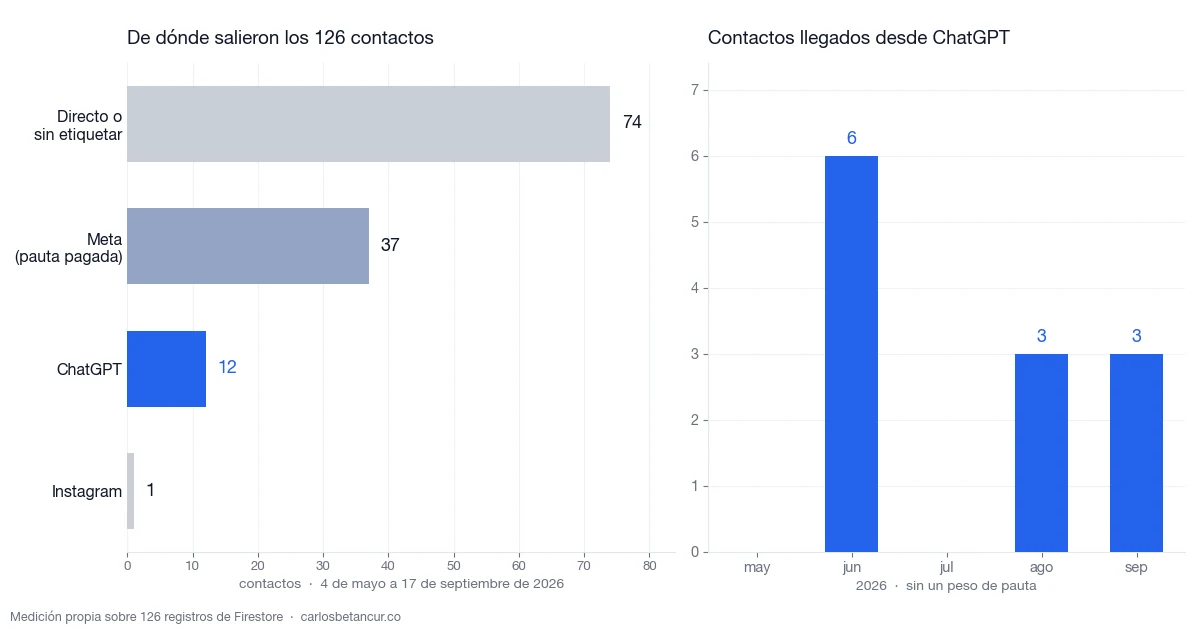
Between 4 May and 17 September 2026 my site captured 126 leads. Twelve of them came from ChatGPT, at zero media cost. Over the same period a paid Meta campaign brought 37, at COP 2,679 per lead across a five-day run.
This is not an estimate or a borrowed case study. These are records from my own database, counted one by one. I am publishing them because I have spent months reading articles about optimising for AI search without seeing a single measured number behind them.
I am Carlos Betancur Gálvez, a digital marketing and AI consultant based in Medellín, Colombia.
Where did the 126 leads come from?
| Source | Leads | Media cost |
|---|---|---|
| Direct or untagged | 74 | 0 |
| Meta, paid campaign | 37 | COP 2,679 per lead |
| ChatGPT | 12 | 0 |
| 1 | 0 | |
| Another referring site | 1 | 0 |
| My own test submission | 1 | 0 |
| Total | 126 |
Put another way: of the 89 leads that did not come from paid advertising, ChatGPT accounted for 13.5%.
How do I know they came from ChatGPT?
Because ChatGPT appends a tag to the links it surfaces: ?utm_source=chatgpt.com. When someone clicks a link inside an answer, that tag travels with the visit.
My form stores it alongside every record, which is why I can count them. Most sites receive these visits and never look, because nobody checks the source field when a lead arrives.
You can verify this on your own site today. Search for chatgpt.com in your analytics traffic sources, or in the source field of your CRM. The data is probably already there.
When did they arrive?
| Month, 2026 | Leads from ChatGPT |
|---|---|
| May | 0 |
| June | 6 |
| July | 0 |
| August | 3 |
| September (to the 17th) | 3 |
The first appeared on 5 June. July came in at zero, and with numbers this small that may be plain variance. I am not going to invent an explanation for it.
What does hold up is that this was not a one-off spike. Leads appear in three of the five months measured.
What were they after?
Eleven of the twelve downloaded my digital marketing book. Only one took the medical marketing book.
That makes sense. My digital marketing and AI content is broader and matches the kind of thing people ask an assistant. The medical content is local and specific, and that sort of query still happens mostly in traditional search.
What I cannot conclude, and why
This is the part usually missing from articles on this topic.
I cannot compare lead quality. The tempting claim was that paid leads left a phone number and ChatGPT leads did not. It is true and it means nothing: the digital book form, which is where eleven of the twelve came in, did not ask for a phone number until 14 September. All twelve arrived before that date. The difference is in the form, not in the people.
I do not know how many more came from AI assistants. There are 74 leads with no source tag. Some may have come from an AI answer that did not tag the link, or from someone typing the address by hand. The 13.5% is a floor, not a ceiling.
The numbers are small. Twelve leads over four and a half months. Enough to say the channel exists and can be measured. Not enough to forecast anything.
This is one site in one niche. Do not generalise it to your business without measuring your own.
The other side: ranking first and getting no clicks
While those twelve did click, my Search Console shows the opposite pattern on the English side.
A seventeen-word conversational query, “what is the most reliable ai tool for managing timelines, tasks, emails, and social content creation?”, recorded 403 impressions at average position 1.3 and zero clicks over 90 days.
It is not alone. All of these show zero clicks:
| Query | Position | Clicks |
|---|---|---|
| affordable ai sales automation for bogotá businesses | 2.5 | 0 |
| colombia-based ai adoption consultant for smbs | 3.6 | 0 |
| ai tools for non technical founders | 1.0 | 0 |
| best ai | 1.0 | 0 |
Nobody types “colombia-based ai adoption consultant for smbs” into a search box. And ranking at position 1.0 for “best ai” is not possible in a normal results page.
What fits these patterns is AI-mode query fan-out: when someone asks a question in natural language, the engine generates synthetic sub-queries and gathers sources for each. Those register as first-position impressions without any human ever seeing a link. I cannot prove it from the outside, but it is the explanation that best fits the data.
What this means in practice
Three conclusions, weighted by what the data actually supports:
First, the channel exists and is measurable today. No new tool required: the tag arrives with the visit and is probably already sitting in your CRM.
Second, the cost comparison is real but misleading. Those twelve leads were not free. They are the result of years of published content. The honest framing is not “ChatGPT brings free customers” but rather: the content you already have keeps working through a new channel that nobody is charging you for.
Third, the click is no longer the only measure. Between twelve people who did come through and 403 impressions that produced no visit at all, the conclusion is that part of your content is being read by machines that answer on your behalf. What is left to win there is not the click: it is being the brand the answer names.
How I measured it
- Period: 4 May to 17 September 2026.
- What I counted: form submissions in the site database, one per person.
- How I classified source: by the
utm_sourceparameter stored with each record, and by referring site when the parameter was missing. - Search data: Google Search Console API, last 90 days.
- Ad cost: Meta platform figure for the
libro-medico-sep2026campaign, which ran for five days.
Anyone with a form and a source field can repeat this count on their own site. That is precisely the point.
Frequently asked questions
Can ChatGPT send real leads to a website?
Yes, and it can be measured. On my site it produced 12 of 126 leads between May and September 2026 with no ad spend. The visits arrive carrying utm_source=chatgpt.com in the link.
How do I check how much traffic I get from ChatGPT?
Look for chatgpt.com as a source in your analytics, or check the source field in your CRM. ChatGPT tags the links it surfaces, so the data is already there if you are storing it.
Is ChatGPT referral traffic high quality? My data cannot answer that. I tried to compare by whether leads left a phone number and found it was a form artifact, not a real difference between people. I would rather say so than invent a conclusion.
Why do I rank first and get no clicks? Because many of those impressions are not a person looking at results. They are sub-queries the engine generates to build an AI answer. The impression is real; the human who saw it is not.
Does this mean SEO is dead? No. The prize changed. It used to be the click; for many informational queries it is now being the source of the answer and the brand that gets named. What you need for that is close to what you always needed, better structured.
How much did the Meta campaign cost? It brought 37 leads at COP 2,679 each over five days. That is a cost-per-lead comparison, not a comparison of quality or close rate.
Can I run this measurement on my own business? Yes, and I recommend it. You need to store the source parameter with every lead and then actually look at it. If you are not storing it today, start there: it is one more field on your form.
If you want help setting this up, that is what I do as an AI consultant. For the other half of the problem, being named inside the answer, I wrote about it separately.