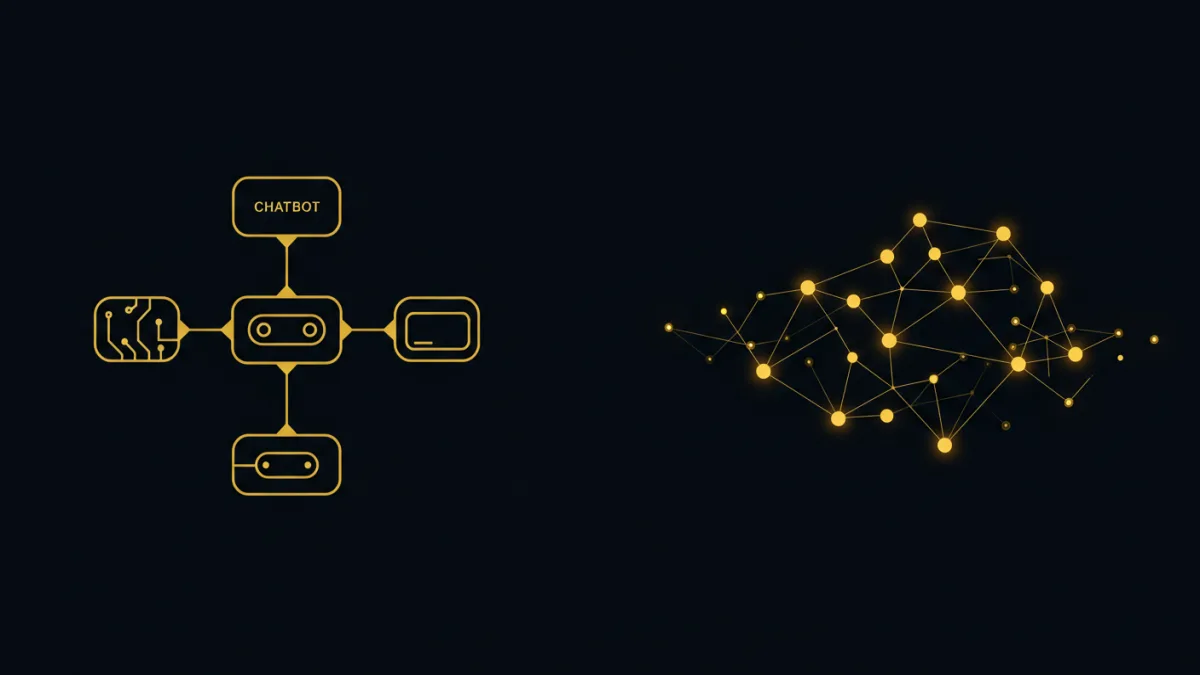
Conversational AI for Business: Agents, Not Bots
A strategic guide to conversational AI for business in Latin America: what AI agents are, where they create real value, and how to start without failing.


AI, digital marketing and medical marketing consultant · btodigital
I have spent years building artificial intelligence in production for companies across Latin America and Spain, and talking about it as an AI keynote speaker in Honduras, Colombia, Ecuador, Costa Rica, Aruba, Bonaire, Curaçao, Chile and Spain, plus classrooms like UPB, EIA, EAFIT, Fenalco and the Medellín Chamber of Commerce. In every one of those rooms I hear the same confusion: people think “adding a chatbot” and “using conversational AI” are the same thing. They are not. And that confusion is the number one reason so many projects end up in the trash.
This is the guide I wish I had when I started. No fluff.
What is conversational AI for business?
Conversational AI for business is the technology that lets software understand natural language, hold the context of a conversation and respond usefully, the way an informed member of your company would. Unlike a rules-based chatbot (which follows a fixed decision tree (“type 1 for sales, 2 for support”)), an AI agent interprets what the customer actually wants, even if they misspell it, ask in an unexpected way or change the subject halfway through. In practice, it is the difference between a form disguised as a chat and a digital employee that serves, qualifies and sells.
That distinction is everything. If you take one idea from this article, let it be this: you are not buying a chatbot, you are hiring a digital employee. And an employee gets trained, given context and supervised.
How is an AI agent different from a rules-based chatbot?
A rules-based chatbot is a button machine. It works fine as long as the customer behaves exactly as the designer imagined. The problem is that real customers do not read scripts. They ask three things at once, use slang, send voice notes, write “how mach is it” and still expect you to understand.
An AI agent, by contrast, relies on large language models to grasp the intent behind the message. I build most of mine on Claude, and the difference in the conversation is night and day. I go deeper into this comparison in the article on AI agents versus traditional chatbots, but here is the summary I use in my talks:
| Dimension | Rules-based chatbot | AI agent |
|---|---|---|
| Understanding | Keywords and buttons | Intent in natural language |
| Context | Forgets every message | Remembers the whole conversation |
| Typos | Breaks | Understands them anyway |
| Maintenance | Reprogram every flow | Adjust instructions and knowledge |
| Human handoff | Rigid or nonexistent | With full context |
| How it feels | ”I’m talking to a machine" | "I’m being taken care of” |
It is not that rules-based chatbots are useless. For an opening-hours menu or a three-question FAQ, they work and they are cheap. But if your goal is to sell, qualify or resolve, they fall short fast.
Where does conversational AI create real value?
This is where I separate the hype from the usefulness. Conversational AI is not there to help you “look modern”; it is there for three concrete things that move the needle of a business.
24/7 service without hiring more people
Most businesses in Latin America lose customers outside working hours, simply because no one answers at 9 p.m. or on a Sunday. An AI agent is always available, with the same tone, never tired. It does not replace your team: it absorbs the repetitive volume so people can focus on what truly requires human judgment.
Lead qualification before a human steps in
This is, to me, the most profitable and most underrated use. A good agent asks the right questions (budget, urgency, location, need) and hands your salesperson a warm lead instead of a “hi, info.” I built an AI-powered doctor finder that manages more than 400 professionals, and much of its value lies precisely in understanding the patient’s query and routing it before a person gets involved.
Conversational sales
Selling by chat is an art, and conversational AI does it at scale. An agent can recommend products, handle common objections, share prices and guide the customer to the close. I devote a whole article to how to use conversational AI to sell in Latin America, because the detail matters: a bot that dumps a catalog is not the same as an assistant that converses like a salesperson.
If you want to see it by industry and with the technical implementation detail, at btodigital we build AI-powered WhatsApp assistants for companies tailored to each sector.
Why do so many conversational AI projects fail?
I will be honest: I have seen more AI projects fail for non-technical reasons than for the technology itself. The patterns repeat so often that I wrote a dedicated guide on why AI projects fail in small businesses. Here is the short version.
The first is treating the agent as software rather than an employee. No one hires a salesperson, sits them down with no training and expects results. AI is the same: without good context, without knowledge of the business and without supervision in the early days, the agent answers generically and disappoints.
The second is trying to automate 100% from day one. Conversational AI shines when it coexists with your team, not when it tries to replace it overnight. The model that works is a hybrid team: AI handles the volume and the human leads the complex. I develop this idea in the article on building a team of digital employees with AI agents.
The third is picking the wrong channel or breaking your existing operation to install it. And I want to address that separately, because in Latin America there is one channel that dominates everything.
How does WhatsApp coexistence work?
In Latin America, business conversation lives on WhatsApp. Industry studies suggest that WhatsApp penetration in the region beats almost any other channel, and my experience on the ground confirms it: the customer does not want to fill out a form, they want to message you.
The most common fear business owners raise with me is this: “If I add AI, do I lose my usual number? Does it break what I already have?” The short answer is no, if you do it right. It is possible for AI and people to work on the same number, in coexistence, without migrating lines or losing your chats. It is a topic with technical nuances (there are important differences between the WhatsApp app and the API) that I explain in depth in WhatsApp coexistence: app and API.
This point is so critical that it was one of the reasons we built Atendio the way we did. When a client tells me they want to try AI but cannot afford to change their number, coexistence on their current number stops being a technical luxury and becomes the condition for even getting started.
Why is the traditional funnel turning into conversation?
For twenty years digital marketing was framed as a funnel: attract traffic, capture the email, nurture with emails, close. That model still holds value, but it is mutating. Today’s customer does not want to walk through five steps: they open a conversation and expect to resolve things right there.
Conversational AI is what makes that shift viable at scale. Before, handling every individual conversation was impossible without an army of people. Now an agent can sustain thousands of simultaneous conversations, each one personalized. It is a paradigm shift I cover in detail in from the funnel to the conversation: we stop pushing people down a pipe and start conversing with them.
There is also a new front no decision-maker should ignore: more and more people ask ChatGPT, Gemini or Perplexity which business to hire. Getting those AIs to recommend your company is a separate game, and I cover it in the guide on how to get ChatGPT and Gemini to recommend your business.
How do you start well with conversational AI?
After dozens of implementations, this is the path I recommend, no shortcuts.
Start with a concrete, measurable goal. Not “I want AI,” but “I want to answer pricing questions after hours” or “I want to qualify my campaign leads before passing them to sales.” A clear goal tells you what to build and how to know if it worked.
Give the agent real context. Its answers are only as good as the information you provide: catalog, prices, policies, FAQs, brand tone. A well-fed agent answers like your best employee; an empty one, like a generic search box.
Design the handoff from day one. The question is not “whether” a human will need to step in, but “how” they will receive the conversation. If the agent hands over the chat with no context, the customer has to repeat everything and the experience is ruined. That is why I insist so much that the handoff preserve the full thread.
Start in coexistence and measure. Let the agent handle part of the volume while your team watches, corrects and fine-tunes. Within a few weeks you will know what to automate more and what to leave in human hands.
Ready to put this into practice? Try Atendio for free: aI-powered WhatsApp assistants that serve customers in Spanish, keep the context when handing the conversation to a human, and run in coexistence with your current number. See plans and pricing.
Conversational AI is not magic, nor a passing fad. It is a new and very concrete way to serve, qualify and sell, available today to any business in the region that implements it wisely. If you avoid the typical mistakes and start with a clear goal, coexistence and good context, the difference shows up fast in your operation and in your sales.
Frequently asked questions
What is the difference between conversational AI and a chatbot?
A traditional chatbot follows a tree of fixed rules and buttons; it breaks when the customer steps off the script. Conversational AI understands natural language, remembers context and responds flexibly, the way an informed person would. In practice, one feels like filling out a form and the other like being taken care of.
Does conversational AI replace my support team?
No, and anyone selling it that way is misleading you. The model that works is hybrid: AI absorbs the repetitive volume and is available 24/7, while people focus on the cases that require judgment, empathy or negotiation. AI expands your team’s capacity, it does not eliminate it.
Can I use my current WhatsApp number with an AI agent?
Yes. With a coexistence setup, AI and your team can work on the same number without migrating lines or losing your conversations. It is one of the differentiators behind the way we built Atendio, because changing numbers is a barrier that stops most businesses.
How much does it cost to implement conversational AI?
It depends on scope, but this is no longer technology only for large companies. There are tools with affordable plans for small businesses, and the real cost has to be weighed against the sales you lose today by not answering in time. A single customer recovered after hours usually pays for the investment.
How soon will I see results?
If you define a concrete goal and give the agent good context, the first results (resolved queries, qualified leads) show up within the first few weeks. The key is to start in coexistence, measure and fine-tune, instead of trying to automate everything on day one.
Which businesses benefit most from conversational AI?
Any that receive chat inquiries regularly: retailers, clinics and practices, professional services, education, real estate. The greater the volume of repetitive conversations and the more each customer is worth, the higher the return. If your customers already message you on WhatsApp, conversational AI almost always makes sense.