AI Agents vs Chatbots: Which One You Need
AI agents vs chatbots, explained without the hype: what truly sets them apart, concrete examples, and which one your business actually needs.
Digital Marketing, Medical Marketing & AI Consultant · btodigital
I’ve spent years building conversational automation for companies across Latin America: WhatsApp agents, chatbots powered by Claude, an AI-driven directory that curates more than 400 healthcare professionals. And the question business owners ask me most is nearly always the same: “Is what they sold me a chatbot or an AI agent?” Almost no one can answer it, which is exactly why they end up paying for something they don’t need. This article settles the difference once and for all, with no marketing in between, so you can decide with real judgment.
What’s the real difference between an AI agent and a chatbot?
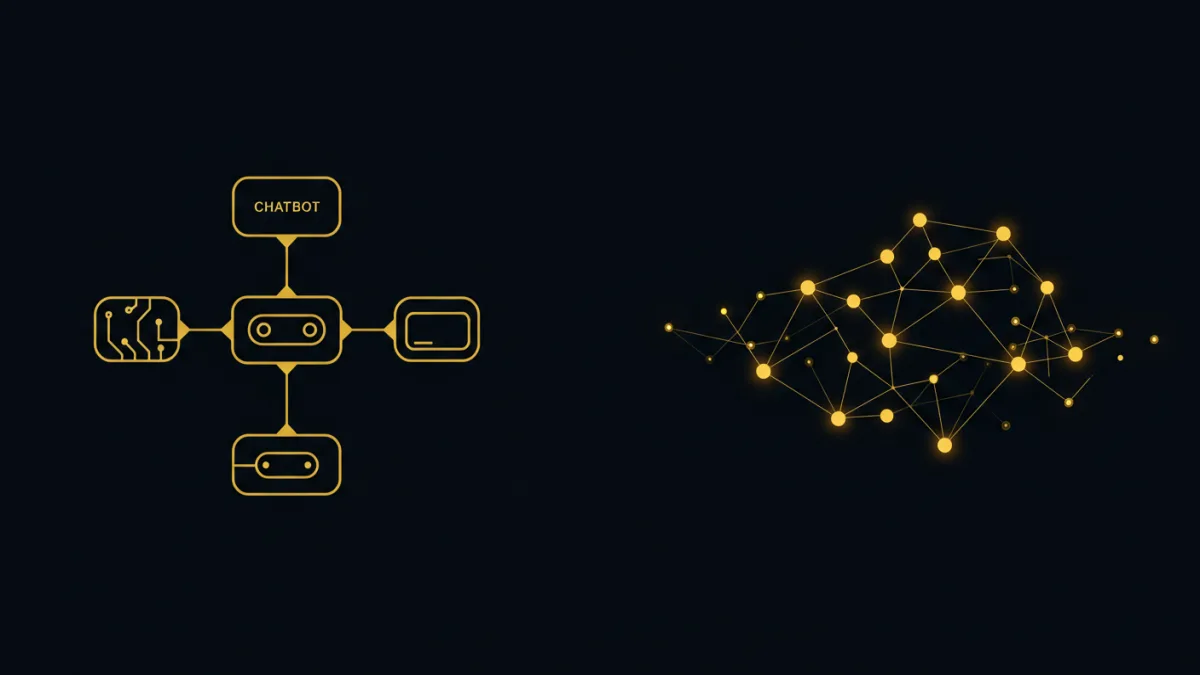
A traditional chatbot follows a script: rules and decision trees someone programmed in advance. If the user says A, it replies B; if they say something the script doesn’t cover, it gets lost. An AI agent, by contrast, reasons about what you tell it, decides what to do, uses tools (querying a database, booking, charging, searching your catalog) and executes tasks from start to finish. The chatbot replies; the agent acts. That’s the core difference, and everything else follows from it.
Put another way: a rules-based chatbot is a form dressed up as a conversation. An agent is a digital teammate that grasps intent, even if you type it badly, in slang, or half-finished, and can chain several steps together to actually resolve something.
How does a rules-based chatbot work?
A rules-based (or flow-based) chatbot runs on “if this, then that” logic. Someone draws a diagram: buttons, menu options, keywords that trigger predefined answers. It’s deterministic and predictable, and that has value: you know exactly what it will say on every branch.
The trouble starts when the customer goes off-script, and they always do. They write “I need to move my Thursday appointment because a meeting came up,” and a bot that only understands the “Reschedule” button has no idea what to do. People don’t speak in buttons. In my experience, that’s precisely where these bots lose the conversation, and with it, the sale or the customer. They feel rigid because they are.
How does an AI agent work?
An AI agent relies on a large language model (like Claude) to interpret what the user actually wants. Instead of hunting for an exact match to a script, it understands intent and then decides the steps. What makes an agent powerful isn’t just that it “talks nicely”: it’s that it has tools and uses them.
A well-built agent can:
- Check inventory or the catalog in real time before answering.
- Verify availability and book an appointment on the real calendar.
- Pull up the customer’s history to add context.
- Escalate to a human when the case calls for it, handing over the whole conversation so the person doesn’t start from zero.
In the WhatsApp agents we’ve built, this ability to “reason and then execute” is what turns a simple chat into a completed task: an appointment booked, an order taken, a question answered with real data instead of a canned reply. If you want the full picture, I wrote a guide on conversational AI and agents for businesses in Latin America that works as a general map.
Comparison table: rules-based chatbot vs AI agent
| Dimension | Rules-based chatbot | AI agent |
|---|---|---|
| How it understands | Keywords and predefined buttons | Interprets intent in natural language |
| What it does | Returns scripted text | Reasons, uses tools, executes tasks |
| Context | Limited to the current flow branch | Holds the thread of the whole conversation |
| Off-script | Freezes or repeats the menu | Adapts and rephrases |
| Integrations | Basic or none | Catalog, calendar, CRM, payments |
| Human handoff | Usually cuts off with no context | Escalates with the full conversation |
| Maintenance | Reprogram every new case | Adjust instructions and knowledge |
| When to use it | Fixed, short, repetitive flows | Real support, sales and operations |
| Main limitation | Fragile against the unexpected | Needs good design and quality data |
When is a rules-based chatbot enough?
Not everything needs an agent. A rules-based chatbot does its job well when the task is narrow and unchanging: a menu of hours, a three-question satisfaction survey, a yes-or-no event RSVP, giving the branch address. If the flow is short, predictable and doesn’t require grasping nuance, a button-based bot is cheap, stable and enough.
The mistake is using it for what it isn’t. When you expect a decision tree to handle complex sales, resolve complaints or hold a human conversation, it breaks. And a bot that frustrates the customer does more harm than having no bot at all.
When do you need an AI agent?
You need an agent when the business outcome depends on understanding the person and executing something real. Support that resolves, not that tangles. WhatsApp sales where you have to answer specific questions, recommend based on the catalog and close. Scheduling that truly checks availability. Re-engaging dormant customers with a relevant message instead of a copy-paste.
In practice, most businesses that come to me want the latter even though they arrive asking for “a chatbot.” They’re after results, more appointments, more sales, less operational load, and a rigid script rarely delivers that. So for real business goals, the right answer is almost always an agent. If you want the strategic angle, I develop it in why your team needs digital employees, and to avoid stumbles it’s worth reading why AI projects fail in small businesses before you invest.
Is an AI agent always better?
No. A poorly implemented agent, without good instructions, without access to the right data, without clear limits, can make up answers or promise what it shouldn’t. Technology doesn’t replace judgment. An agent is only as good as the knowledge you give it, the tools you connect and the guardrails you set. I’ve seen projects fail not because of the model, but because they were launched without curating the information or defining what it must NOT do.
The rule I follow: use the simplest tool that solves the problem. If a rules-based bot is enough, use it. If the problem demands reasoning and executing, invest in a well-designed agent. The expensive part isn’t the agent; it’s implementing either one badly.
How do I choose for my business?
Ask yourself three honest questions. Is the task fixed, or will people ask in a thousand different ways? Do I only need to answer, or also to do something (book, charge, look up)? What does each conversation lost to a bot that didn’t understand cost me? If your answers point to variability, execution and revenue impact, you’re heading toward an agent. If everything is fixed, short and low-risk, a rules-based bot will serve you.
And if you operate in Latin America, some details matter: that it handles Spanish well, that it coexists with your current WhatsApp number, and that when a human steps in, the context isn’t lost. Those nuances are the difference between a pretty demo and something that truly works day to day.
Want an AI agent, not a rules-based bot? Try Atendio free: aI WhatsApp assistants that serve customers in Spanish, keep the context when handing off to a human, and work in coexistence with your current number. See plans and pricing.
If you’d rather see how this lands by sector, at btodigital we build AI WhatsApp chatbot implementations tailored to the industry and use case.
Frequently asked questions
Is an AI agent the same as ChatGPT?
Not exactly. ChatGPT is one interface to a language model. An AI agent uses a similar model as its “brain,” but it also has tools connected (your catalog, your calendar, WhatsApp) and executes tasks inside your operation. The model thinks; the agent acts on your business.
Are rules-based chatbots useless now?
They’re still useful, for their lane. For short, fixed, low-risk flows they remain a cheap and reliable option. The problem is using them for complex support or sales, where people don’t speak in buttons and the script falls short.
Can an AI agent replace my human team?
In my experience, it doesn’t replace it: it amplifies it. The agent handles the repetitive, high-volume work and escalates to a person the cases that require judgment. The ideal is coexistence, where the human leads when needed and the agent hands over full context.
Do I need to change my WhatsApp number to use an agent?
You shouldn’t have to. Good solutions work in coexistence with your current number, so your team and the agent serve customers on the same line without migrating contacts or losing history.
How much does an agent cost compared to a chatbot?
It depends on scope, not on the label. A simple rules-based bot is cheaper to set up, but it gets expensive when you have to reprogram it for every new case. An agent costs more in initial design, but tends to pay off better as volume and complexity grow, because you adjust it with instructions and knowledge instead of rebuilding it entirely.
What do I need ready before launching an agent?
Curated, clear information: what you sell, prices, policies, answers to frequent questions and, above all, what it must NOT do or promise. Most failures I’ve seen aren’t about the technology, but about launching it without that upfront work on data and limits.