WhatsApp AI Agents for Business: How to Automate in 2026
How WhatsApp AI agents work and why they are the cheapest automation for businesses in Latin America. Real cases and costs.

AI, digital marketing and medical marketing consultant · btodigital
In Colombia, WhatsApp is the default channel. Practically anyone with a phone has it, and it is where your customers ask questions, compare options and decide whether your business is worth their time, often before you know they exist. You will see 98% open rates quoted against 21% for email; I could not find a primary source that holds those numbers up, so stick to what is verifiable: what arrives on WhatsApp gets read, and gets answered far faster than email.
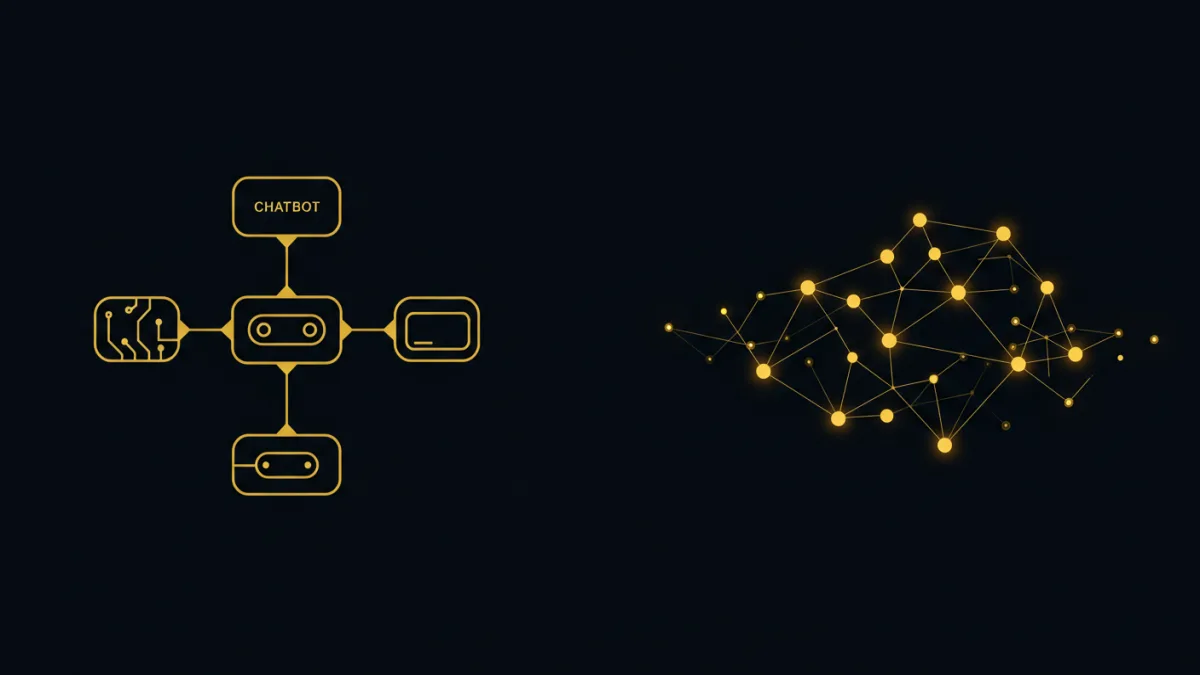
A WhatsApp AI agent is not a menu-based chatbot. It’s a system that understands natural language, remembers conversation context, accesses your knowledge base and can escalate to a human agent when needed. All automatically, 24/7.
Today, for most businesses, what I recommend is Atendio, our platform of AI WhatsApp assistants. Here’s how an agent like this works, what pieces it has and when it makes sense to build a custom one.
What Can (and Can’t) a WhatsApp AI Agent Do?
Can do:
- Answer frequently asked questions using your specific business knowledge
- Qualify leads (profile purchase intent, budget, urgency)
- Send documents, catalogs or files in response to requests
- Remember conversation history within a session
- Escalate to a human when it detects a question outside its scope
- Send scheduled follow-up messages to new leads
- Receive and process voice messages
Shouldn’t do:
- Close deals that require complex negotiation without human supervision
- Completely replace human contact in high-value processes
- Operate without a well-structured knowledge base
AI Agent vs. Traditional Chatbot vs. Human Support
| Capability | Traditional Chatbot | AI Agent with Claude | Human Support |
|---|---|---|---|
| Availability | 24/7 | 24/7 | Business hours |
| Natural language understanding | Low (keywords) | High | High |
| Conversation memory | Per simple session | Session + persistent profile | Variable |
| Per-user personalization | Minimal | High (A/B/C profiling) | High |
| Base monthly cost | USD 0–50 | USD 5–50 | USD 600+ per agent |
| Response time | < 1s | 2–8s | 5 min – 4 h |
| Scalable to 1,000 conversations/day | Yes | Yes | No (without large team) |
| Best use case | Menu options, simple FAQs | Qualification, contextual FAQs, smart escalation | Closing complex sales, high-value post-sales |
What Technical Stack Powers a Production WhatsApp Agent?
A custom-built WhatsApp agent usually has these pieces:
- Meta Cloud API: direct connection to WhatsApp Business Platform
- A language model (Claude, Gemini or another) to reason and generate replies
- Firestore for session persistence and user profiles
- Cloud Run (GCP) as the serverless backend
- Webhook for real-time message reception
Building and maintaining it takes technical time. If you’d rather not, Atendio has all of this solved: you connect your number and start.
What Use Cases Have I Implemented in Real Companies?
Aesthetic clinic with 3 locations: the agent qualifies leads, answers procedure questions, sends pricing information and books appointments directly into the clinic’s calendar system. Reduced average response time from 4 hours to under 2 minutes.
Distribution company: the agent answers questions about product availability, order status and commercial policies using a knowledge base connected to the CRM. Freed the sales team from answering ~60 repetitive questions per day.
My own prospecting bot: profiles website visitors who message via WhatsApp, sends relevant books as PDFs based on the prospect’s interest, logs information to Firestore and notifies me when a qualified lead needs personal attention.
When Does It Make Sense to Build a WhatsApp Agent?
A WhatsApp AI agent makes sense when:
- You receive more than 20 WhatsApp inquiries per day and response time affects your close rate
- You have recurring questions that consume your team’s time
- You operate outside business hours and lose leads that won’t wait until the next day
- You have a qualification process that could be automated (budget, service type, urgency)
It doesn’t make sense when:
- Your message volume is low (fewer than 5–10 per day)
- Every conversation is completely unique and requires expert judgment from the first message
- Your sales process depends 100% on personal relationship from the very first contact
What’s the Most Common Mistake When Implementing One?
Most businesses want to automate everything from day one. The result: a bot that doesn’t know the business well, gives generic answers and frustrates customers.
The right approach is to start with a specific, bounded use case (lead qualification, FAQ responses, information delivery) and expand gradually once the agent has a solid knowledge base.
Atendio: the ready-made agent that puts your WhatsApp on autopilot
Everything I describe here, we turned into a ready-to-use product: Atendio is the AI agent that answers your company’s WhatsApp, qualifies leads and responds 24/7, in natural Spanish and in your brand’s voice. Instead of building the stack from scratch, you connect your number and go. Its differentiators are the ones that matter in day-to-day operations: coexistence (you keep the same number and your team keeps replying from the usual phone while the AI answers alongside them), genuine Spanish for Latin America (warm, not robotic translations) context-aware handoff (when a case needs a person, the agent escalates the conversation with the full history, so the customer never has to repeat anything) and 24/7 coverage with no shifts or holidays. It’s the fast track when you want the outcome without building the infrastructure yourself.
Keep your number, qualify and reply 24/7 in Spanish, and hand off to your team when needed. Get started free in minutes.
If you want to explore whether a WhatsApp agent makes sense for your operation, visit my AI consulting with Claude page or message me directly via WhatsApp.
For related reading, explore how RAG technology powers business knowledge systems that back these agents with real data, learn about optimizing WhatsApp Business for sales to strengthen your overall messaging strategy, and compare the AI platforms in Claude vs ChatGPT vs Gemini for business to understand what drives these agents behind the scenes.